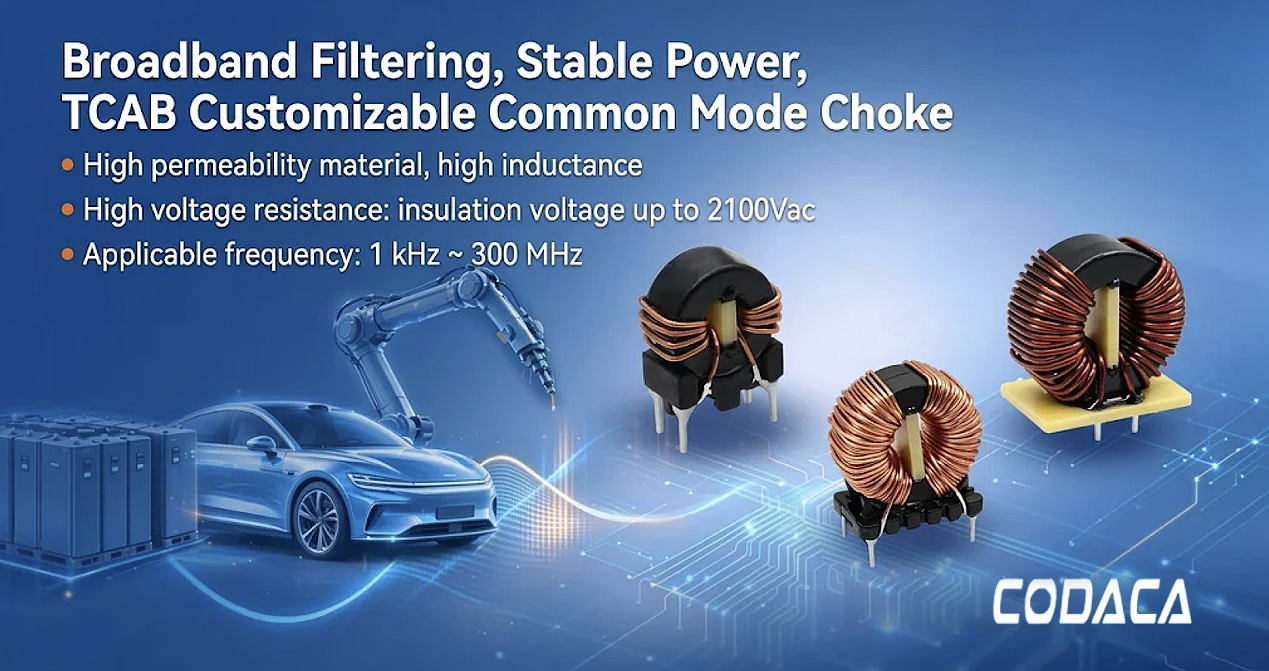
In the development and design of industrial, energy storage, and automotive auxiliary power supplies, EMI filtering capability is a critical link in ensuring stable system operation and passing EMC compliance testing. Moreover, the selection and engineering application of common mode chokes directly determine the common-mode noise suppression performance of the power system. Independently developed and manufactured by Codaca, the TCAB series of customizable common mode chokes has passed AEC-Q200 reliability testing and features superior characteristics such as broadband high common-mode impedance, high dielectric withstanding voltage, and a wide operating temperature range, providing a high-reliability magnetic component solution for power line common-mode filtering.
1. Common-Mode Noise: A Major Challenge in Power Supply EMC Debugging
In scenarios such as automotive electronics, industrial control, and energy storage power supplies, conducted common-mode interference on power lines is prevalent. This noise readily triggers equipment malfunctions, signal fluctuations, and EMC compliance test failures, thereby prolonging project debugging cycles. A high-performance, highly reliable common mode choke tailored for power line filtering serves as a core component in power supply design.
Independently developed by Codaca, the TCAB series of customizable common mode chokes utilizes high-permeability nanocrystalline magnetic core materials specifically engineered for power line common-mode filtering applications. Built to rigorous standards, this series integrates broadband filtering, high dielectric withstanding voltage, wide-temperature stability, and miniaturization into a unified common-mode filtering solution, establishing a clean and stable power delivery path for power rails.
2. Product Overview of the TCAB Series Common Mode Chokes
This series currently offers 6 standard part numbers: TCAB110506RS, TCAB150709RS, TCAB180808RS, TCAB231010RS, TCAB281613RS, and TCAB382117RS.
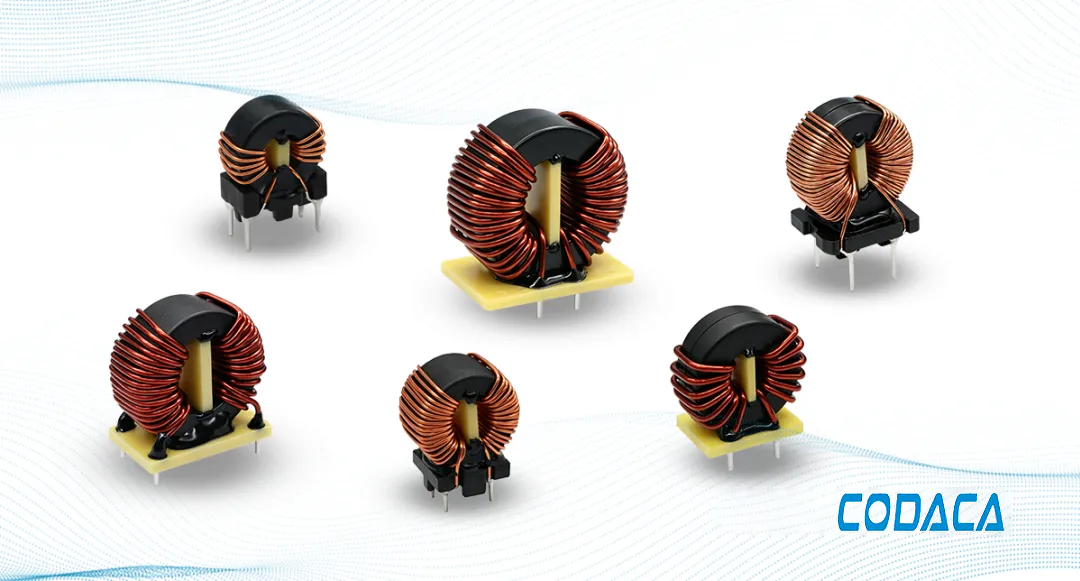
The primary parameters of the TCAB common mode choke series are as follows:
▪ Inductance Range: 400 to 190,000 μH (Nominal value, tested at 10 kHz / 0.1 V)
▪ Rated Current: 0.60 to 26.0 A (Defined at ΔT = 40 K, Ta = 25 ℃)
▪ Rated Voltage: 300 V
▪ Dielectric Withstanding Voltage: 2100 Vac
▪ Operating Temperature: -55 to +125 ℃ (including inductor self-heating)
▪ Flammability Rating: UL94 V-0
3. Six Core Values of the TCAB Series
3.1 High-Permeability Magnetic Core: Superior Performance Enabling One Component to Replace Two
Designed with a low-loss, high-permeability magnetic core material, the TCAB series achieves a broad inductance range of 400 μH to 190 mH under test conditions of 10 kHz / 0.1 V, providing abundant selection margin for filter circuit design.
The initial permeability (μi) of the TCAB series core reaches 60,000 to 100,000, which is 4 to 30 times that of conventional Mn-Zn ferrites (typically μi = 2,500 to 15,000). This means that for an identical inductance requirement, the TCAB series requires fewer winding turns, resulting in lower winding DC resistance (DCR) and significantly reduced full-load copper loss and temperature rise. Conversely, for an identical number of turns, it delivers higher inductance, greater common-mode impedance, and superior low-frequency insertion loss.
More critically, the effective permeability of ferrite cores attenuates rapidly above 1 MHz to less than 30% of its low-frequency value, making it difficult to cover the 30 to 300 MHz radiated emission band. In contrast, the TCAB series maintains high permeability across the full 1 kHz to 300 MHz frequency spectrum, exhibiting only a gradual decline at high frequencies due to eddy current losses. Consequently, a single TCAB common mode choke can replace the multi-stage combination of 'ferrite common mode choke + high-frequency ferrite bead' in conventional solutions, simplifying the BOM, reducing procurement costs, and saving PCB board area.
3.2 2100 Vac High Dielectric Strength: Seven-Fold Safety Margin
With a dielectric withstanding voltage of up to 2100 Vac, the series effortlessly handles grid fluctuations and transient overvoltages. In applications such as industrial power supplies and automotive on-board chargers (OBCs), power line filters must withstand lightning surges, switching transients, and grid switching overvoltages. The TCAB series offers a dielectric withstanding voltage of 2100 Vac (50 Hz, 1 min), providing a 7-fold safety margin relative to the rated operating voltage of 300 V (RMS). For a 230 Vac grid (325 V peak), the voltage margin exceeds 6 times the peak value; even when facing a 277 Vac industrial grid (392 V peak), a 5.4-fold peak margin is maintained.
The insulation structure utilizes a high-temperature-resistant bobbin and flame-retardant epoxy resin encapsulation. Creepage distances and clearances between windings and from windings to the bobbin are optimized to meet the spacing requirements for basic insulation under IEC 60950 / IEC 62368, allowing direct deployment at power input stages requiring reinforced insulation.
3.3 -55℃ to +125℃ Wide Temperature Range: No Low-Temperature Embrittlement, No High-Temperature Demagnetization
Operating across -55℃ to +125℃ (including inductor self-heating), the series exhibits minimal inductance drift over the entire temperature range. The Curie temperature (Tc) of the TCAB series core typically exceeds 500℃, far higher than that of ferrites (typically Tc = 120 to 250℃). At an operating temperature of 125℃, there is virtually no permeability degradation, and the inductance temperature coefficient (αL) is typically < ±0.02 %/K. Total inductance variation across the full temperature range is controlled within ±2%, ensuring filtering performance does not degrade due to thermal drift.
At the low-temperature extreme of -55 ℃, the TCAB series avoids the core embrittlement and micro-cracking commonly seen in ferrites, maintaining stable mechanical strength and magnetic properties to satisfy harsh cold-start scenarios in aviation, outdoor energy storage, and cold-climate automotive applications.
3.4 AEC-Q200 Qualified: Universal Compatibility Across Industrial, Energy Storage, and Automotive Sectors
The TCAB series has passed AEC-Q200 reliability testing, covering a comprehensive suite of severe operating conditions including high-temperature storage, temperature cycling (-55 ℃ to +125 ℃), mechanical shock and vibration, damp heat resistance, and resistance to soldering heat. It is not only suitable for industrial power supplies and energy storage inverters, but also applicable to EMI filtering on automotive electronic power lines such as automotive OBCs (On-Board Chargers), DC/DC converters, and BMS (Battery Management Systems). This eliminates the need for customers to conduct additional component-level reliability verification, shortening project qualification cycles.
For industrial and energy storage customers, AEC-Q200 equally represents an elevated reliability benchmark, making it the preferred choice for long-life, high-availability systems. Having passed the full suite of AEC-Q200 passive component reliability tests—enduring severe stresses such as temperature cycling, vibration, and damp heat—the series demonstrates strong aging and shock resistance, fulfilling the requirements for long-term stable service in industrial, energy storage, and automotive auxiliary equipment.
3.5 Strong Customization Capability: Flexible Adaptation Across 6 Standard Models
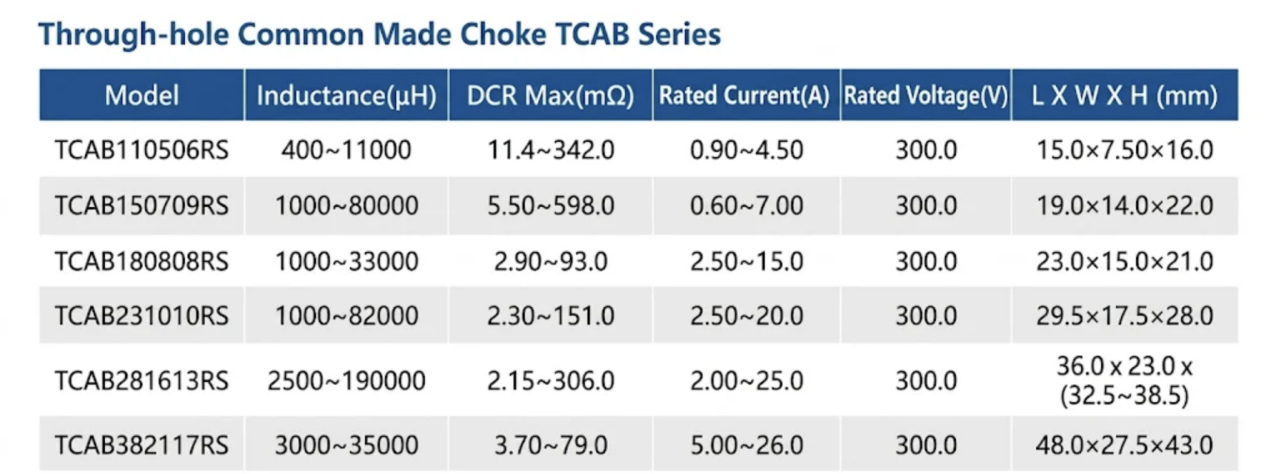
Based on 6 standard models (see Table 1), the TCAB series covers a broad inductance range of 400 μH to 190 mH and a current range of 0.6 to 26 A, meeting the EMI filtering requirements of power supplies across diverse power ratings.
Table 1: Specifications and Electrical Parameters of the TCAB Series
More specifications and part numbers will be continuously introduced in the future.
On the foundation of standard products, Codaca additionally offers flexible customization services:
▪ Inductance Value Customization: The number of winding turns can be precisely adjusted to achieve specified inductance values, aligning with customers' target cut-off frequency and insertion loss requirements.
▪ Lead Terminations Customization: Supported styles include through-hole (THT), formed leads, and extended leads to adapt to different PCB thicknesses and mounting methods.
▪ Package Dimensions Customization: Within the allowable range of the magnetic core window, the bobbin height and pin pitch can be adjusted to fit compact chassis.
▪ Safety Standards Compliance Customization: In response to specific safety certification needs (e.g., UL, VDE, CQC) in target markets, certification support and sample coordination for testing can be provided.
3.6 Miniaturized Design, Saving PCB Space
While achieving identical inductance values, the magnetic core volume of the TCAB series is significantly smaller than that of ferrite solutions. Taking a 10,000 μH (10 mH) common mode choke as an example, the outer diameter of the TCAB series magnetic core can be as small as 15 to 19 mm, whereas ferrite solutions typically require an outer diameter of 25 to 35 mm, resulting in a volume reduction of approximately 50% to 70%.
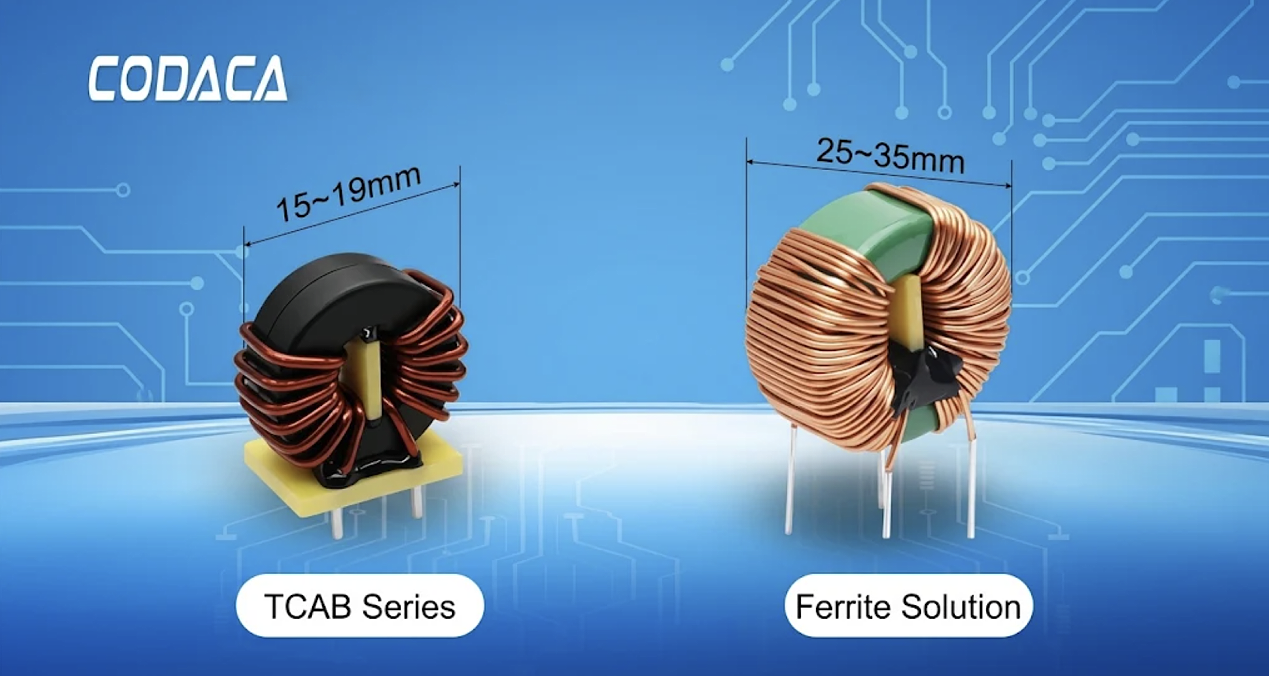
Product Dimensions Comparison: TCAB Series vs. Ferrite Solution at Identical Inductance Values
The TCAB series utilizes standard through-hole technology (THT) packaging, with pin pitch and hole positions adhering to industry-common specifications, ensuring compatibility with wave soldering and manual soldering processes to facilitate automated production and maintenance replacement. The miniaturized design not only conserves PCB area but also provides greater layout flexibility for space-constrained scenarios such as high-density power modules, compact inverters, and automotive controllers.
4. Application Scenarios
The TCAB series of common mode chokes is suitable for industrial switching power supplies, industrial control equipment, energy storage power supplies, and automotive auxiliary power supplies, reinforcing the power system's EMC defenses. Balancing filtering performance and long-term reliability, the TCAB series common mode chokes represent a premium selection for power engineers regarding power line common-mode filtering.
Deeply rooted in magnetic components for many years, Codaca possesses the capabilities of independent inductor research and development, custom development, and large-scale delivery. Should you require sample evaluation, parameter customization, or technical liaison, please feel free to contact Codaca!