As automotive systems evolve toward electrification, intelligence, and connectivity, the complexity of vehicle electronic systems has grown exponentially. A high-end intelligent vehicle now integrates over a hundred Electronic Control Units (ECUs), while advanced driver-assistance systems (ADAS), high-computing domain controllers, Automotive Ethernet, and Battery Management Systems (BMS) impose rigorous requirements on electromagnetic compatibility (EMC) performance.
Meanwhile, PCB layout space is continuously constrained by the trends toward vehicle lightweighting and integration. The conventional discrete combination scheme of common-mode and differential-mode inductors in EMC filtering circuits occupies an excessively large board area, making it difficult to balance high performance with miniaturization. Driven by magnetic integration innovation, Codaca's VSDN0650A series automotive-grade common mode chokes integrate both common-mode and differential-mode noise suppression into one compact package. Delivering exceptional EMI filtering in a minimal footprint, the series offers a dependable solution for space-constrained, high-density automotive electronics.
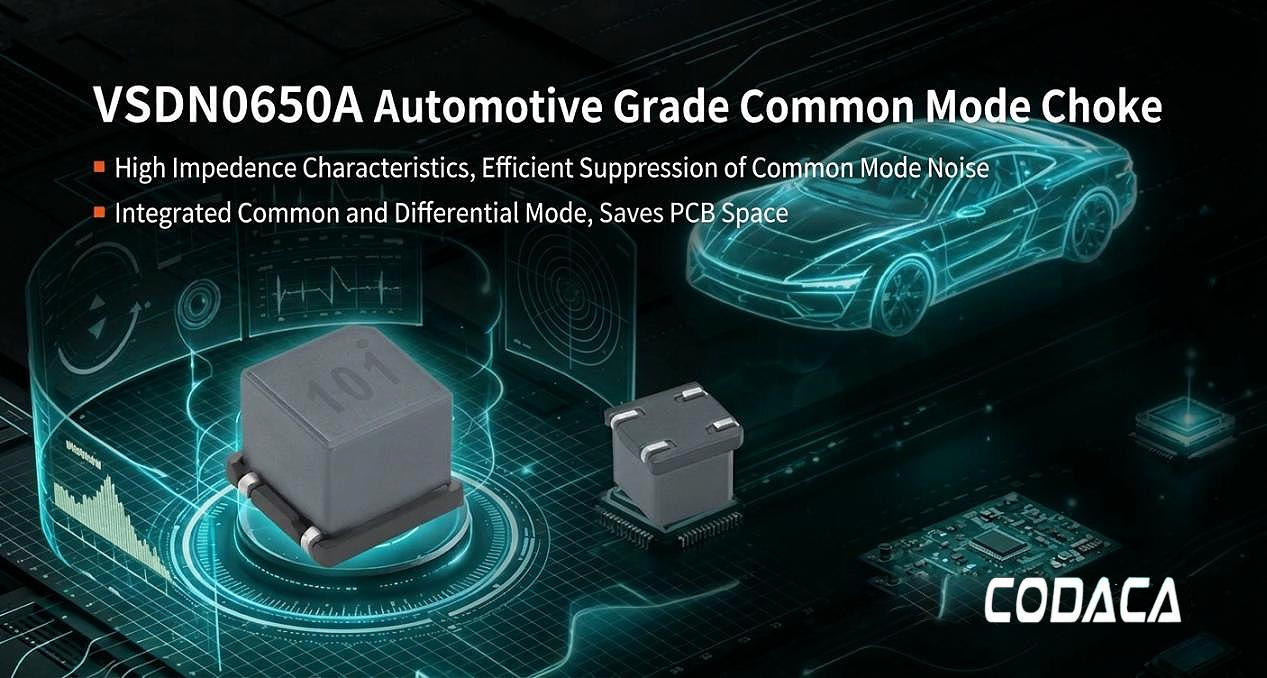
1. Electromagnetic Compatibility (EMC): The Reliable Foundation of Automotive Electronics
Electromagnetic Compatibility (EMC) is essential for automotive electronics to function properly in complex vehicle electromagnetic environments, covering two key aspects: Electromagnetic Interference (EMI) and Electromagnetic Susceptibility (EMS). Good electromagnetic compatibility (EMC) performance is directly related to driving safety, functional stability, and overall vehicle quality, with its importance reflected in the following three aspects:
◾ Ensuring Stable Execution of Critical Functions: In-vehicle equipment with robust EMC performance can effectively withstand internal and external interference sources—such as motor start-stop transients, high-voltage switching, and wireless communication frequency bands—preventing signal distortion, false triggering, or abnormal control commands, thereby ensuring zero-fault operation of critical automotive electronic systems.
◾ Enhancing Multi-Domain Collaborative System Reliability: In complex systems where multiple automotive electronic devices operate concurrently (such as in-vehicle infotainment and powertrain control units), effective EMC design significantly suppresses inter-module crosstalk, enhances overall system immunity, and safeguards signal integrity and communication stability, thereby extending the service life of the vehicle's entire electronic architecture.
◾ Meeting Automotive-Grade Regulations and Standards: Both international and domestic standards establish explicit specifications for electromagnetic emissions and immunity in electronic products (such as automotive EMC test standards like CISPR 25 and ISO 11452). Furthermore, automotive electronic components must pass reliability qualifications such as AEC-Q200 to ensure long-term stability in harsh vehicular environments. Compliant design is not only a fundamental prerequisite for market entry, but also critical for mitigating legal risks and overcoming trade barriers.
2. Key Essentials of Automotive Electronics EMC Design
Throughout the automotive electronics product development lifecycle, EMC design must be integrated across the entire chain, encompassing system architecture design, schematic capture, PCB layout, structural design, and material selection. The following essentials are particularly critical:
(1) Layout and Shielding: By properly partitioning high-frequency, low-frequency, and power loops, interference coupling paths are minimized. Metal shielding cans paired with conductive foam are employed to enclose noise sources, effectively suppressing radiated emissions, while sensitive circuits are shielded and isolated to enhance system electromagnetic immunity.
(2) Filtering and Grounding: Appropriate filters—such as common mode chokes, differential mode inductors, and X/Y capacitors—are configured at power ports and signal interfaces to attenuate conducted interference. Simultaneously, a low-impedance grounding system is established to provide reliable discharge paths for electrostatic discharge (ESD) and surge currents, with particular attention paid to the transient characteristics of 12V/48V automotive power systems.
(3) Material Selection: High-permeability, low-loss, and wide-temperature-stable magnetic materials are selected for inductors and ferrite beads to ensure stable performance across an operating temperature range of -55°C to +155°C. Shielding materials must balance electrical conductivity with mechanical strength to withstand vibration and thermal cycling conditions.
(4) Automotive-Grade Qualification Requirements: Automotive electronic components must pass reliability certifications such as AEC-Q200 to guarantee long-term stability in harsh vehicular environments. Products must comply with EMC test standards such as CISPR 25 and ISO 11452, as well as the specific testing specifications of individual Original Equipment Manufacturers (OEMs).
3. Limitations of Conventional Common-Mode and Differential-Mode Inductors in EMC Design
As mature filtering components, common-mode chokes and differential-mode inductors have been widely adopted to suppress conducted interference at automotive power inputs. However, they encounter significant bottlenecks in next-generation automotive electronics designs:
◾ Restricted Applicable Frequency Bands: Conventional common-mode and differential-mode inductors are primarily engineered for low-frequency EMC filtering (ranging from tens of kHz to several MHz) at power input stages. For downstream high-frequency signal processing circuits—such as high-speed data lines and RF front-ends—their parasitic parameters and frequency responses are no longer suitable.
◾ Insufficient Differential-Mode Suppression Capabilities: At signal filtering stages, surface-mount common-mode chokes are typically employed to attenuate common-mode noise, requiring alternative measures to suppress differential-mode interference. Common approaches include:
(1) Increasing the leakage inductance of the common-mode choke to leverage its equivalent differential-mode inductance for filtering. However, leakage inductance is governed by multiple variables—including core geometry, winding processes, and material consistency—making precision difficult to control and resulting in poor batch-to-batch consistency during mass production;
(2) Adding discrete chip inductors, air-core coils, or ferrite beads, or even relying on the parasitic inductance of PCB traces to achieve differential-mode filtering.
These conflicts are particularly acute in highly integrated architectures such as autonomous driving domain controllers and cockpit domain controllers—when PCB real estate is compressed to its physical limits, conventional layouts accommodating both discrete common-mode and differential-mode inductors become virtually unfeasible.
4. Automotive Electronics EMC Solutions
Faced with the dual pressures of size constraints and EMC performance in automotive applications, magnetic integration technology has emerged as the breakthrough solution. Codaca's VSDN0650A series adopts an innovative common-mode and differential-mode magnetic integration structural design (patented technology), seamlessly fusing both filtering functions to provide a novel paradigm for automotive EMC filter design.
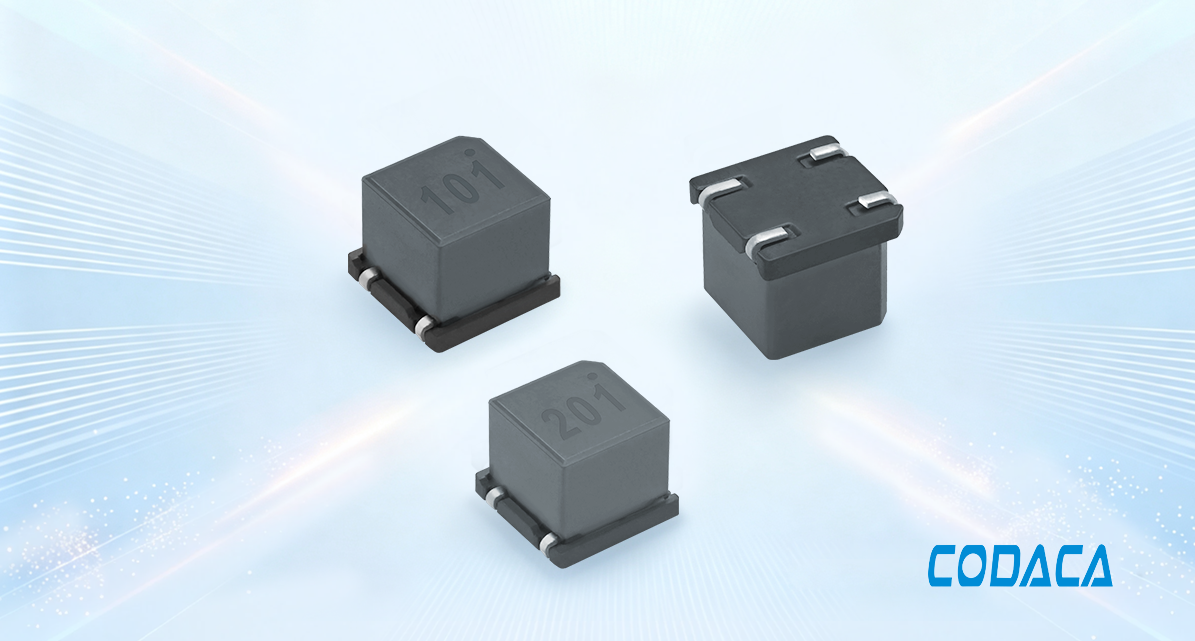
Codaca Automotive-Grade Common Mode Choke VSDN0650A Series
(1) Core Product Innovations
◾ Integrated Magnetic Architecture: Combines common-mode and differential-mode filtering into one component, completely eliminating separate differential-mode inductors in select topologies. This drives higher power density and smaller footprints while drastically cutting component count and PCB real estate.
◾ Advanced Core Geometry: Built on an E+] core structure with a closed magnetic path to curb flux leakage and boost inductance precision. The rectangular center leg maximizes the effective cross-sectional area, vastly improving saturation resistance so the differential-mode section handles high peak currents without dipping. It also keeps the profile low for space-saving, low-profile board assembly.
◾ Comprehensive Shielding Structure: Features a dual-shielding design consisting of a closed magnetic path plus an external metallic enclosure. This blocks external EMI, curbs outward magnetic radiation, and keeps signal transmission distortion to a bare minimum—easily satisfying rigorous CISPR 25 Class 5 radiated emission standards.
◾ Flat-Wire Edge-Winding Technology: Reduces inter-winding capacitance, boosts the Q factor, slashes high-frequency losses, and pushes up the self-resonant frequency (SRF), making the component a perfect fit for high-frequency signal processing environments.
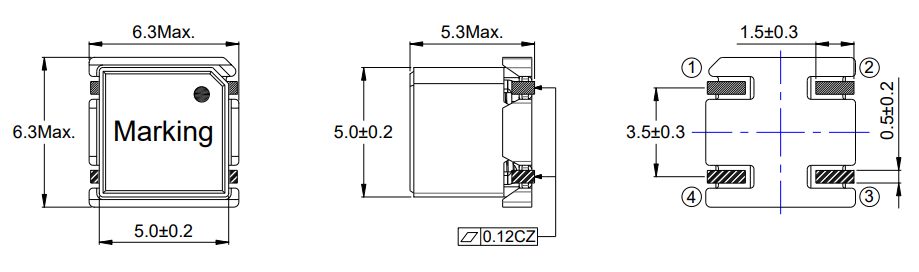
Outline Dimensions
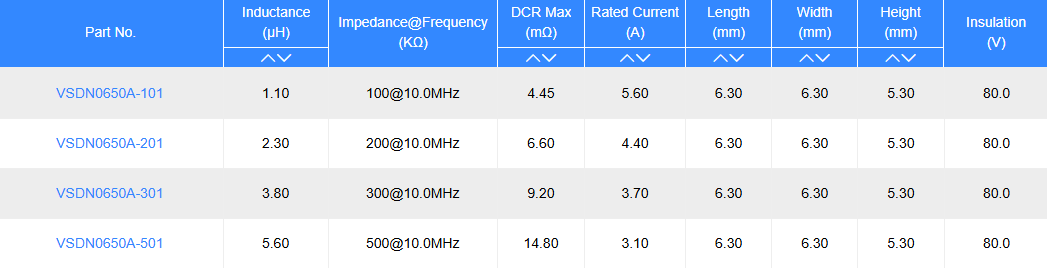
Specifications & Electrical Parameters
(2) Solution Value
The value brought by the automotive-grade common mode choke VSDN0650A series to automotive electronics EMC design can be summarized as follows:
① Area Reduction: The magnetic integration design eliminates the need for independent differential mode inductors, reducing PCB occupied area by 30% to 50% and supporting system integration with higher power density.
② Performance Enhancement: The E+] shaped structure and magnetic shielding design effectively improve inductance precision and anti-interference capability, while the rectangular center post ensures anti-saturation margin.
③ High-Frequency Suitability: The wide-frequency and wide-temperature magnetic core material and flat-wire winding process increase the self-resonant frequency (SRF), enabling this series of inductors to be applied for EMC filtering in high-frequency environments above 10 MHz.
④ Reliability Improvement: Stronger anti-saturation and anti-leakage characteristics ensure stable filtering performance in harsh environments (such as vehicle temperature cycling and vibration).
⑤ Flexible Installation: The ultra-low height design adapts to narrow chassis and meets compact and flat installation requirements.
⑥ Wide Operating Temperature: -55℃ to +155℃ (including inductor self-heating).
(3) Application Scenarios
① Automotive Powertrain/Safety Equipment
Used for automotive equipment directly related to vehicle driving, steering, braking, safety devices, etc., or equipment whose structure, equipment, and performance are required by law to meet safety guarantee or environmental protection technical standards.
◾ BMS Battery Management System
◾ OBC On-Board Charger
◾ DC/DC Converter (High Voltage to Low Voltage)
◾ Motor Drive Control Unit
◾ Electric Power Steering (EPS) System
◾ Electronic Parking Brake (EPB) Control Unit
② Automotive Infotainment/Comfort Equipment
Used for equipment such as automotive navigation, automotive audio, and on-board infotainment systems that are not directly involved in personal safety and are not legally required to meet safety guarantee or environmental protection technical standards.
◾ Power supply and signal filtering for cockpit domain controllers
◾ Display interface for on-board infotainment systems
◾ Common mode rejection for on-board Ethernet interfaces
◾ ADAS environment perception front-end (non-safety-critical camera/radar modules)
◾ On-board display modules
◾ Power supply filtering for automotive audio system amplifiers
③ Industrial and Communication Power Supply Systems
◾ Input/output terminals of switching power supplies
◾ DC-DC converter modules for communication base stations
◾ Effectively filters common-mode conducted interference and meets industrial-grade EMC level requirements.
5. Conclusion
Electromagnetic compatibility design is an important consideration that determines product competitiveness and time-to-market. Codaca's automotive-grade common mode choke VSDN0650A series integrates common mode and differential mode filtering functions into one, complies with the AEC-Q200 reliability certification standard, and provides engineers with an EMC design tool that simplifies complexity through smaller volume, stronger performance, and high-frequency adaptability.
In application areas such as automotive powertrains, intelligent driving assistance systems, on-board infotainment, and new energy management, the VSDN0650A series is a trustworthy electromagnetic barrier on high-density PCBs, helping systems achieve the optimal balance of performance, reliability, and cost.